Why I Built Intelligrade, Even Though I Just Wanted to Give Exams
Steven, Teacher & Co-Founder,
June 19, 2026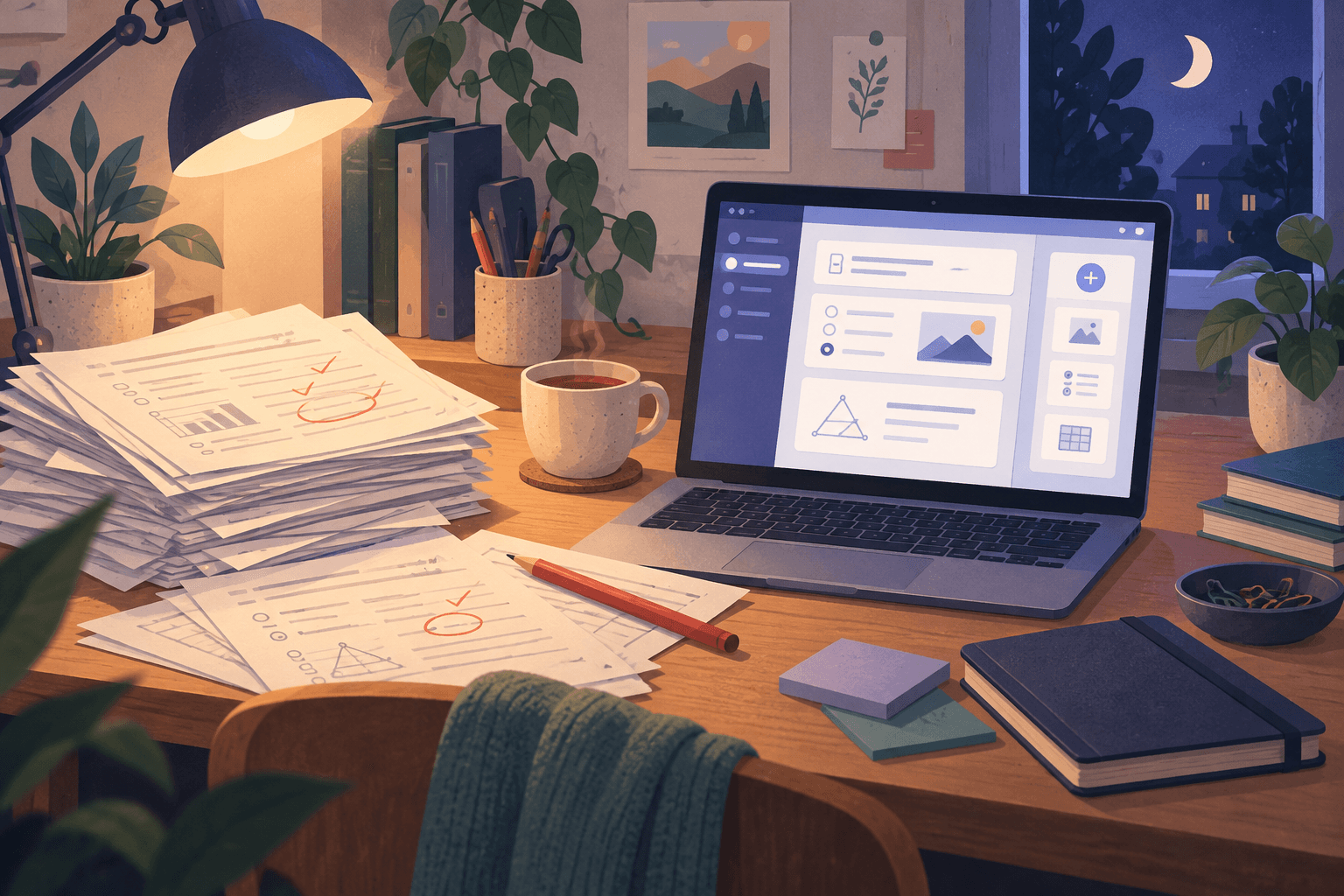
It's Friday evening. On my dining table sits a stack of 28 exams, half of which I still need to get through if I want to enjoy even a sliver of my weekend. I have a cup of tea next to me (I don't drink coffee, though I'm questioning that decision right now), a red pen in my hand, and it's half past ten. I won't be done before two in the morning. And on Monday I'll be standing in front of a class again at eight.
If you're a teacher, you know these evenings. They're not the reason we became teachers. Nobody in teacher training ever said: "The best part of this job is marking papers." We wanted to teach. We wanted to explain things, spark discussions, accompany young people through their development. Instead, we spend a significant portion of our lives with a red pen and a points tally. I know it matters. But it drives me absolutely mad.
My name is Steven. I teach at a secondary school in Hamburg, and my subjects are Philosophy and Biology. And that Friday evening was one of many reasons why Intelligrade exists today.
The Moment Everything Clicked
In 2022, the Hamburg education authority presented its drafts for new curriculum frameworks. Buried inside was a sentence that set something in motion for me: from now on, students are required to write at least two exams per semester that incorporate the use of computers. The curriculum itself puts it even more directly: in secondary education, exams must be set in which traditional formats are partially or fully replaced or extended by digital tools.
That's not a suggestion. That's a requirement.
And I was excited. Genuinely. I was already a fan of digital teaching. The potential of digital exams seemed obvious to me: new task formats that wouldn't be possible, or would be much harder, on paper. Automatic marking of many question types, meaning fewer Friday evenings with a red pen. And above all: more time for what teachers are actually trained to do: Planning lessons and working with students.
The holy grail, I thought. Finally. All I need now is the right tool.
The Frustration Begins
I did what every teacher in Hamburg has probably done in recent years: I searched. I tested. I compared. For months, I tried tool after tool. I even co-led a full-day staff training session on exactly this topic for my school colleagues.
It became an exhausting journey.
The first tool was designed for universities, great for exams with 300 students, but completely over-engineered for my class of 28 with its correction phase, parental review, and sign-off process.
The next one offered exactly three question types: multiple choice, fill-in-the-blank, matching. That was it. Where were the open-ended questions? Where was the marking rubric? An exam made up entirely of tick-box tasks isn't an exam. It's a quiz.
Other platforms came across like arcades: soaring point counters, sound effects, animal and alien avatars racing each other in rockets and competing for the top spot on the leaderboard. Gamification. Fine for vocabulary practice. Not appropriate when 30 to 50 percent of a student's semester grade depends on this particular piece of work.
Then came the data protection chapter: one tool advertised GDPR compliance, which on closer inspection meant: "We store student data on servers in California and track our users' behaviour." I didn't dare explain that to my school's data protection officer.
Another promised automatic marking, but was so open that students could easily browse the web for answers in a parallel tab. I at least wanted the option of not having to patrol the room like a starving shark circling behind every student's back.
And then there was the one tool that had actually got most things right. But like those luxury shops where the price tags are missing because if you have to ask, you can't afford it, the pricing for a school licence was available on request only, bookable exclusively through the school administration. I, a single teacher who just wanted to try something out quickly, had no chance. And convincing my entire staff body was like tilting at windmills.
After months of testing, I had found exactly one tool I could basically use. But it didn't come close to delivering what an analogue exam offers, let alone what a digital one actually could. I used it anyway. The curriculum required it, after all.
The Moment the Idea Came
It was during a free period. Back to marking. This time a digital exam I'd set using the one halfway-decent tool from my search. Something felt off. The exam was dull, full of repetitive question types. And honestly? I'd barely saved any time. To cover the higher levels of thinking, I still had to include open-ended questions that didn't have automatic marking, and my options for giving feedback on spelling or adding annotations were simply limited. Then a thought crashed into my head:
"If I can't find a tool that works, I'll just build one myself."
Half naive, half defiant. I'm a teacher, not a software developer. But I had a good friend: Kevin. We'd known each other since school. He was a software developer who had worked freelance for, among others, HSV and Fielmann. If anyone knew how to build a platform that could really hold up, it was him.
I called him. Explained the problem. Walked him through the market I'd just systematically road-tested. Told him: "Kevin, there's a curriculum requirement that now mandates digital exams. There are teachers who genuinely want to do this. And there isn't a single tool out there that actually does what we need. Let's build one."
Four years later, we built it. Insane.
What We Learned Over Those Four Years
If you build a tool for a profession you don't belong to, you'll fail. That's why we had an unfair advantage: I am the first user. Every feature, every design decision, every workflow. I thought through all of it from a teacher's perspective. Not from the perspective of a tech founder who wants to "disrupt education."
We had countless conversations with other teachers, and I of course listened to every frustrated rant I could catch in the staffroom. Through all of that, it gradually became clear what every tool had been ignoring: an exam isn't just the act of students sitting and writing. It's a cycle. It begins with creating the exam and doesn't end until the teacher has collected all the corrected papers with parental signatures.
That's exactly what we needed to map.
So we designed and discarded countless ideas and concepts. Despite the time difference (Kevin was living in Japan at the time), we lost ourselves in details. Through endless video calls and coding sessions, which probably cost Kevin more late nights than all my marking piles combined, he took my often unknowingly demanding real-world requirements and turned them into working software, again and again. He pulled so many of my teeth that I probably should have needed dentures years ahead of schedule. But every time, he came back with an even better solution.
And then, one day, we suddenly had the first usable version.
What Intelligrade Is Today
Today, Intelligrade covers the entire exam cycle: from creation through to the exam itself, the teacher's correction, the student's revision, and the parental sign-off. Exactly the cycle that every tool I'd tested had ignored.
All the common question formats from traditional analogue exams have been brought into the digital space and extended with formats or variations that simply wouldn't be possible on paper. Multiple choice, fill-in-the-blank, matching, categorisation, image labelling, ranking, true or false, and classic open-ended questions with marking rubrics. All in one tool.
Intelligrade marks all question types automatically. Open-ended answers are pre-corrected in the Pro version using AI assistance. The AI generates feedback texts based on your level of expectations, checks spelling, and even calculates an error quotient. Comprehensive commenting, feedback, and annotation tools give teachers all the options they're used to from analogue marking. And the best part: the final call on right or wrong, on points, grades, and comments always stays with the teacher. Everything can be adjusted and overridden. The AI is a tool, not a teacher.
Throughout all of this, Intelligrade takes our students' data seriously. Our servers are hosted by Hetzner in Germany. All our data processors are based in Europe: Mistral (France) for AI marking, Brevo (France) for email communication, Creem (Estonia) for payment processing. We deliberately use no tracking tools, which means we don't let data crawlers anywhere near our website. That's also why there's no cookie banner on our site.
Intelligrade runs on almost all operating systems and devices, and the Pro subscription includes the Safe Exam Browser to prevent cheating. During an exam, the student's device is locked to the task at hand. No second tabs, no sneaking off to AI tools in the background. The Safe Exam Browser, by the way, also comes from Europe - Switzerland, to be precise.
And above all: Intelligrade is accessible to individual teachers. You don't need a school contract or procurement processes. You can sign up today and run your first digital exam tomorrow. You can try it for free, and even with the free version you can run fully-featured exams. And if you decide to subscribe, you can cancel at any time without having to fight your way through a manipulative obstacle course designed to make it as hard as possible.
Why I'm Writing This
I'm not writing this to sell you a product. Well, okay, partly I am. But mostly I'm writing it because I know that somewhere out there, right now, another teacher is spending a random weekend evening on exactly the same tour through exactly the same tool graveyard that I started four years ago. And I'm writing it for every teacher who values what a traditional exam can do, but would dearly love to get some of that time back.
If that's you: you don't have to go through this yourself. We already did.
Go to intelligrade.de, sign up in a few clicks, and try it out.
And if you have feedback, write to us. We read every message.